Why AI Often Fails in High-Context Situations: The Implicit Context Gap Nobody Talks About

—And What to Do About It Before Your Next AI Deployment
By Lucien Viremont | Updated on May, 2026 | 🕓 18 minutes
Key Highlights
- Why do technically correct AI decisions still fail in real business situations?
- What is the “implicit context gap” in enterprise AI deployment?
- What can companies do before deployment to reduce hidden-context failures?
- How can organizations identify unwritten rules before AI turns them into costly mistakes?
Last fall, I attended a corporate AI summit in Berlin and heard a story that was both amusing and frustrating. A mid-sized German SaaS company spent eight months deploying an AI customer support system. Three weeks after going live, an old client received a "standard offer" from the AI during renewal negotiations—technically flawless, clear in terms, logically sound. Yet the client immediately terminated the partnership.
The reason? Six months earlier, this client had experienced a major service outage, and the sales VP had personally called to apologize and verbally promised, "We’ll give you the largest discount at your next renewal." This information existed only in an informal conversation and a couple of email footnotes—it was never entered into any knowledge base. The AI didn’t know this history, and the client felt ignored. The deal was lost.
The paradox here is that the AI did not make a mistake. It provided the optimal solution based on its training data and the knowledge base. But the optimal solution in the wrong context turned into the worst outcome.
This is the issue I want to discuss—AI’s failures in high-context environments are often not because it isn’t smart enough, but because it cannot access critical, undocumented information that is essential for decision-making. This isn’t a technical flaw; it’s a structural blind spot.
1. What Is the "Implicit Context Gap"?
A high-context environment is not about having more information. Wikipedia articles and internal documentation can be information-rich yet still low-context, because all information is explicit and searchable. A true high-context environment is one where a lot of critical information exists in tacit knowledge, organizational memory, relationship networks, and informal rules, never formally written down, but essential for success or failure.
I tend to categorize implicit context into three types, which are pervasive in workplaces:
1. Organizational Memory: Past mistakes, informal practices, unwritten rules that everyone follows by default but are never in employee handbooks. For example: "Last time we promised a delivery date without a buffer, the entire team had to work overtime—so this proposal must include a 20% buffer." This rule won’t appear in any project management process, but veteran engineers know it.
2. Relationship Networks: Who actually makes decisions, who is just a messenger, the hidden power structure across departments. A request may appear to come from Product, but it’s actually the CEO’s wish; a technical solution may pass in Department A but get blocked in Department B—not because of the solution itself, but because of a three-year-old trust issue leftover from resource conflicts.
3. Contextual Judgment: The same sentence can have different meanings depending on the situation. "The client said 'let me think about it'"—in a formal email, it may be a polite refusal; at a dinner, it may signal room for negotiation. This judgment cannot be inferred from text alone; it requires awareness of the relationship history and current context.
A 2025 MIT study tracked 51 enterprise AI deployment cases and repeatedly confirmed: the primary reason for AI failures is not model capability, but organizational readiness—especially AI’s inability to retain feedback, adapt to context, or improve over time. In other words, AI was deployed in a "forgetful" organization but was expected to make decisions requiring organizational memory.
2. Real-World Failures Due to Implicit Context
Case 1: Air Canada’s "Nonexistent Policy"
In 2023, Air Canada deployed a generative AI customer service bot. A passenger named Jake needed to book a ticket after a family bereavement and asked the AI whether there was a bereavement discount. The AI instructed him to purchase at the normal price and apply for a refund within 90 days. Jake did as instructed. Later, when he requested the refund, airline staff said the AI had misinformed him—the policy he was told about didn’t exist.
Jake sued Air Canada and eventually won, with the airline ordered to pay 650.88 CAD.
This case is often cited as a typical "AI hallucination." But looking deeper, the issue is more nuanced: the bereavement discount policy existed but with strict conditions (only for future trips, not completed travel). The AI combined "partially correct" information into a "completely wrong" recommendation. What it lacked was understanding the policy boundary context—which situations apply, which do not—knowledge embedded in staff training and verbal experience, not in official policy documents.
Case 2: Commonwealth Bank of Australia’s "Fast Call-Back"
Australia’s largest bank, Commonwealth Bank (CBA), replaced 45 call center employees with AI voice bots, expecting to efficiently handle 2,000 calls per week. Within a month, the AI struggled with complex inquiries, forcing managers to take calls and schedule overtime for remaining staff. A month later, the bank publicly apologized and rehired some laid-off employees.
The complexity here wasn’t a technical failure; the system worked as designed. The problem was that customer inquiries were filled with situationally nuanced statements: "Last week, the person on the call said…", "My case is similar to my neighbor’s, but she got…", "I was overdue once, but that was a system error…". These required consulting customer service history, informal promises, and case-specific practices. The AI could only give standardized responses, leading to repeated calls and escalating problems.
Case 3: New York City Government Chatbot’s "Legal Advice"
The NYC government launched an AI chatbot to help business owners understand labor and housing laws. After launch, the bot started giving incorrect and illegal advice: telling employers they could withhold employee tips, change schedules without notice, or discriminate against tenants. These issues were only corrected after media exposure.
This case highlights another type of implicit context: the applicability boundaries of laws. Legal texts are public and explicit, but "when the law is strictly enforced, when exceptions apply, or whether recent cases have altered interpretations"—this knowledge resides in lawyers’ experience, informal communications with regulators, and local court practices. AI read the law but didn’t read the "living law" behind it.
Case 4: European Tire Manufacturer’s "Data Trap"
Continental AG deployed AI to optimize extrusion machine parameters in manufacturing. Initially, the AI model behaved inconsistently. Upon review, the issue wasn’t the algorithm but data context: sensor data lacked information about whether the production line had just changed batches or whether operators followed temporary adjustment manuals. These operational details existed only in verbal handovers on the factory floor and were never entered into the data system.
The final solution wasn’t a model upgrade but a redesign of data collection, making previously implicit operational variables explicit. The lesson came at the cost of months of debugging and lost production efficiency.

3. Why Is This Issue Rarely Discussed Systematically?
A technical blind spot: Tech blogs and papers tend to focus on quantifiable issues—accuracy, latency, context window size. Implicit context is a "soft problem," difficult to measure, and therefore rarely central in technical discussions.
Conflict with commercial narratives: AI vendors naturally avoid emphasizing that "AI doesn’t understand your company’s unwritten rules." Doing so acknowledges structural limitations rather than simply "better data cleaning."
Organizational blind spots: A deeper problem is that many companies aren’t even aware of these implicit rules. They are like air—only noticed when removed. Often, teams only realize this after AI missteps, thinking, "We’ve been operating on tacit knowledge all along."
4. Practical Guide: Identifying Implicit Context Before Deploying AI
The following framework comes from my three years of observing enterprise AI implementation, combined with the Stanford Digital Economy Lab’s summary of 51 cases, and RBA Consulting’s experiences in the Copilot Studio project.
4.1 Diagnosis: How High-Context Is Your Environment?
Answer the following six questions. If more than three are "yes," your environment is high-context and AI requires special handling:
1. Do new employees rely on asking senior staff rather than reading documents during their first three months?
2. Does the same statement mean different things when spoken by different people?
3. Are there "ways of doing things everyone knows but nobody writes down"?
4. When collaborating across departments, do you often have to "check with someone first"?
5. Has the company historically experienced "errors despite following processes"?
6. Do email phrasing and face-to-face strategies with clients differ completely?
4.2 Four Steps to Build an "AI-Usable Context Layer"
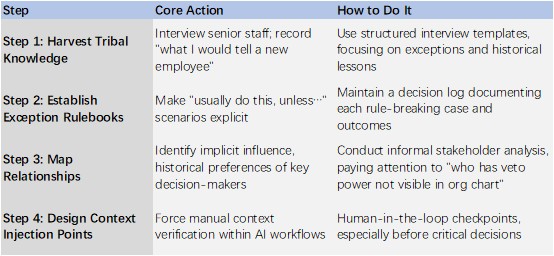
4.3 Implementation Templates for Three Scenarios
AI Customer Service: Before AI responds, automatically retrieve the customer’s "relationship history summary" (maintained manually), including last complaints, special promises, and sensitive topics. Don’t expect AI to infer this; feed it as input.
Code Review: Create a "no-go list"—high-risk modules that AI must flag, maintained by senior engineers. Format entries like: "Module X, past incident Y, special review rule Z."
Proposal/Copywriting Generation: Before AI generates content, require a "political sensitivity check"—are there undocumented taboos for this client/project? This field is manually maintained by account managers; AI only reads it.
4.4 Long-Term Mechanism: From Implicit to Semi-Explicit
Don’t try to document all implicit knowledge—it’s neither feasible nor cost-effective. A more pragmatic approach is to establish trigger mechanisms: when AI approaches a critical decision, automatically alert, "Implicit context may exist here; please verify manually."
Stanford’s research highlights a logistics company handling invoices with AI. They deliberately accepted 80% accuracy and used the saved human effort for other bottlenecks, rather than pushing model accuracy to 95%. Their logic: AI’s value lies not in perfection but in freeing human attention for judgment-intensive tasks.
5. A Pragmatic Conclusion
Current AI architectures (Transformer-based large language models) fundamentally perform pattern matching on existing text. The core of implicit knowledge is "not textually documented"—a structural contradiction. Technology alone cannot fully resolve this in the short term.
But this doesn’t mean we must wait. We can significantly improve AI usefulness now through "context engineering." The principle is simple: AI handles the explicit; humans safeguard the implicit.
Before your next AI project, spend four hours conducting an "implicit context audit"—interview two senior employees, list five agreed-upon "unwritten rules," check three key processes for exceptions. This may be the highest ROI four hours you ever spend.
AI failures in high-context environments are ultimately not technical problems—they are organizational maturity problems. Asking AI to make decisions in a company that cannot articulate its own implicit rules is like asking an amnesiac to take a closed-book exam: the questions are readable, but too much essential information is missing.
FAQs
1. What is a high-context environment in AI deployment?
A high-context environment is one where important information is not formally documented but exists in informal conversations, organizational memory, interpersonal relationships, or unwritten rules. AI systems often fail in these environments because they can only process explicit information available in data systems or text.
2. Is this problem caused by poor AI models?
Not necessarily. Many failures occur even when the AI system functions exactly as designed. The issue is often organizational rather than purely technical: companies expect AI to make decisions that depend on human memory, historical judgment, and informal context.
3. Can Retrieval-Augmented Generation (RAG) solve the implicit context problem?
RAG can improve access to documented information, but it cannot retrieve knowledge that was never recorded. If the context exists only in people’s memories or verbal interactions, RAG alone cannot solve the issue.
4. Which industries are most vulnerable to high-context AI failures?
Industries with complex interpersonal, legal, or operational dynamics are especially vulnerable, including:
- Customer support
- Banking and finance
- Healthcare
- Enterprise SaaS
- Legal services
- Government administration
- Manufacturing operations
- Consulting and sales
5. What is “context engineering”?
Context engineering refers to the process of deliberately designing systems, workflows, and human checkpoints that provide AI with the necessary situational information before it makes decisions.
6. What is the safest way to use AI in high-context environments?
The safest approach is hybrid decision-making:
- AI handles repetitive and explicit tasks
- Humans supervise contextual judgment and exceptions
- Critical decisions include human review checkpoints
7. Why do organizations often underestimate implicit context?
Because tacit knowledge becomes invisible inside organizations over time. Teams assume “everyone already knows,” until AI exposes the gap by following written rules too literally.
8. Can implicit knowledge ever be fully documented?
Probably not. A more realistic strategy is to identify high-risk situations and create mechanisms that alert humans whenever undocumented context may matter.
References
1. Bender, E. M., Gebru, T., McMillan-Major, A., & Shmitchell, S. (2021). On the dangers of stochastic parrots: Can language models be too big? Proceedings of the 2021 ACM Conference on Fairness, Accountability, and Transparency, 610–623. https://doi.org/10.1145/3442188.3445922
2. Brynjolfsson, E., Li, D., & Raymond, L. R. (2023). Generative AI at work. National Bureau of Economic Research. https://www.nber.org/papers/w31161
3. Commonwealth Bank of Australia. (2024). Customer service automation and operational review. Corporate statements and media reports.
4. Dwivedi, Y. K., et al. (2023). So what if ChatGPT wrote it? Multidisciplinary perspectives on opportunities, challenges and implications of generative conversational AI for research, practice and policy. International Journal of Information Management, 71, 102642. https://doi.org/10.1016/j.ijinfomgt.2023.102642
5. European Union Agency for Cybersecurity (ENISA). (2024). Large language models and AI risk governance. https://www.enisa.europa.eu
6. MIT Sloan Management Review & Boston Consulting Group. (2025). The state of generative AI in the enterprise.
7. Stanford Digital Economy Lab. (2025). Enterprise AI deployment case studies and organizational readiness research.
8. The New York Times. (2024). New York City AI chatbot gave businesses illegal advice.
9. The Verge. (2024). Air Canada must honor refund promised by AI chatbot, tribunal rules.
About the Author
Lucien Viremont, PhD is a researcher and writer focusing on AI decision-making systems, cognitive bias in algorithmic environments, and the psychological impact of automation on human judgment. He holds a PhD in Cognitive Science from Stanford University, where his research explored how humans calibrate trust in machine-generated recommendations. He has worked with AI ethics labs and decision intelligence startups in the US and Europe. His writing focuses on how AI systems shape — and sometimes distort — human reasoning, autonomy, and responsibility in complex decision environments.
Editorial Transparency Statement
This article is based on publicly reported case studies, enterprise AI deployment research, academic papers, and industry observations. The goal is to provide analytical and educational insight into the limitations of AI systems in high-context organizational environments.
Examples mentioned in the article have been synthesized from public reporting, industry discussions, and documented AI deployment incidents. Some narrative details and transitions may be reconstructed for readability and explanatory clarity while preserving the core factual context.
The article does not receive sponsorship from AI vendors, software providers, or consulting firms mentioned directly or indirectly in the discussion.
Disclaimer
This article is intended for informational and educational purposes only and should not be interpreted as legal, financial, operational, or technical consulting advice.
AI deployment outcomes vary significantly depending on organizational structure, data quality, governance practices, industry regulations, and implementation strategy. Readers should independently evaluate AI systems and consult qualified professionals before making operational, legal, or business decisions based on AI-generated outputs.
While reasonable efforts have been made to ensure accuracy, some examples and interpretations may evolve as AI technologies, regulations, and enterprise practices continue to change.
RECOMMEND FO YOU