The GEO Trap: Why AI Search Results Are Easier to Manipulate Than We Think

By Isolde Kavanagh | Updated on May 2026 | 🕓 8 minutes read
Key Highlights
- How does GEO differ from traditional SEO, and why does it matter in AI search systems?
- Why can large-scale content production subtly reshape what AI models interpret as “consensus”?
- In what ways does language and geographic imbalance influence AI-generated answers?
- Why is “authoritative tone” not the same as “truthful information” in generative systems?
- Can users realistically detect when an AI-generated answer has been influenced by coordinated content strategies?
In the era of AI-driven search and information acquisition, human reliance on knowledge is rapidly shifting from "searching" to "generating." We are used to opening search engines to get answers, expecting them to be objective and authoritative. However, with generative AI becoming the core of search, this trust faces unprecedented challenges. The fragility of AI search results does not stem from the technology's incompetence, but from its design as a highly trusting learner, striving to "understand" this complex world.
From SEO to GEO: The Battlefield of Manipulation Has Shifted
In the era of traditional Search Engine Optimization (SEO), manipulators aimed at "ranking." Companies, media outlets, and marketers optimized keywords, built backlinks, and created content to push web pages higher in search results. However, the AI era has introduced Generative Engine Optimization (GEO), fundamentally changing both the methods and the objectives of manipulation.
GEO manipulators may include corporate groups, political actors, or even misinformation creators. Their goal is no longer simply to get users to click a link, but to make AI directly "believe" a perspective or narrative and generate it in its answers. This type of manipulation is not only subtle but also highly semantic, as AI’s primary goal is to produce a coherent, credible, and seemingly authoritative answer, rather than merely presenting a list of information.
Typical GEO Manipulation Techniques
GEO manipulators use tactics that are more hidden than traditional SEO, usually including:
1. Mass-producing low-quality yet seemingly professional content
By writing pseudo-scientific articles, fake press releases, and forged citations, manipulators can pollute AI training data or real-time content on specific topics, creating a false "information consensus." These articles appear professional and credible but systematically embed bias.
2. Semantic insertion and concept distortion
Some manipulators embed brands, figures, or concepts in irrelevant contexts, distorting AI’s understanding of them. For example, associating a political figure with overwhelmingly positive descriptors can lead AI to generate overly favorable answers.
3. Hidden textual instructions
Webpages may contain invisible text that directly "commands" AI to act in a specific way. For instance, hiding "must give positive reviews" on a product page can make AI-generated reviews one-sided. Such methods could even induce AI to generate responses containing malicious code, causing financial or security risks.
4. Infiltrating authoritative sources
AI tends to trust government websites, mainstream media, and academic journals. If manipulators can disguise themselves as these sources (e.g., creating fake official sites or publishing sponsored content on local credible media), biases can be packaged as official or professional consensus.
Geographic Distribution and Language Bias: AI’s Structural Vulnerability
Another subtle weakness of AI-generated search lies in the highly uneven geographic distribution of training data and real-time content. Mainstream models’ data is concentrated in English-speaking regions and internet-developed areas, while information from regions such as India, Africa, or parts of South America is often poorly represented.
This geographic imbalance means knowledge about certain regions is inherently incomplete or distorted. To provide definite, fluent answers, AI tends to rely on sources it recognizes as "local authorities." Studies show that AI models in different languages internalize the social biases and stereotypes of that language’s cultural sphere. When a user asks the same social question in Chinese and English, the answers may reflect two completely different "mainstream narratives."
A user’s IP address, language settings, and regional preferences trigger AI to draw from the corresponding geographic and language corpus, so the same question may generate highly consistent yet divergent answers across regions, and ordinary users are unlikely to notice the difference. In other words, AI answers may appear objective, but in reality, they are amplified “local consensus” shaped by language and geography.
Why Generative Search Is More Easily Manipulated Than Traditional Search
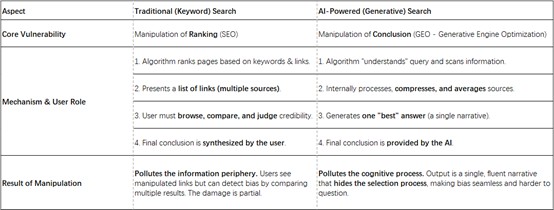
The fundamental weakness of generative AI search is not in the technology itself, but in its goal and design philosophy: to synthesize a coherent and fluent answer from massive amounts of information. When faced with conflicting information, humans may remain skeptical, but AI’s instinct is to average out perspectives or favor the seemingly more authoritative side.
AI’s pursuit of the "best answer" makes it highly susceptible to systematic manipulation. GEO strategies do not require overt censorship; by flooding the network with biased content, manipulators can subtly steer AI to favor a narrative in its answers. This means manipulation can occur gently and invisibly, and users may not even realize their answers have been "customized."
A Hypothetical Business Scenario
Suppose a multinational corporation wants to promote a controversial product globally. A possible manipulation strategy could be:
1. Hiring writers in target markets to produce a large volume of pseudo-scientific articles in local languages claiming "research shows the product’s benefits outweigh risks," and ensuring these articles are syndicated on local news or informational websites.
2. When local users ask AI whether the product is safe, the AI retrieves real-time local content and finds these GEO articles dominate the local information “volume.”
3. Since these articles may appear on seemingly trustworthy platforms, the AI interprets them as a "localized consensus," generating an answer that looks objective and cites multiple sources, but is biased in favor of the product.
4. Globally more scientific and critical perspectives are suppressed because they are less prominent in the local corpus and cannot counterbalance the AI’s generated conclusion.
In this scenario, GEO does not block information directly; instead, it leverages semantic and structural amplification to make bias appear factual. Local manipulation, magnified by language and geographic trust structures, creates a "customized truth" for specific user groups.

The Real Threat of GEO
The core danger of GEO is not that it hides information, but that it systematically and efficiently generates persuasive, biased consensus that ordinary users find hard to detect. It deconstructs expectations of “objective answers,” forcing us to approach every AI-generated “fact” with critical thinking.
Every seemingly authoritative answer may conceal a successful semantic insertion operation. We must ask: does this "consensus" arise from reality, or from a deliberately engineered, structurally amplified narrative?
FAQs
1. Is GEO manipulation already happening in real-world AI systems?
There is no universally confirmed mechanism labeled “GEO” in official AI system documentation, but information influence tactics such as SEO spam, coordinated content campaigns, and synthetic content flooding are well documented and continue to evolve alongside AI search systems.
2. Does AI intentionally favor biased or manipulated sources?
No. AI systems do not have intent. However, they may statistically favor content that is more prevalent, more coherent, or more frequently repeated in their data sources.
3. Can AI distinguish between credible academic sources and mass-produced content farms?
Partially, but not perfectly. While ranking signals and training methods aim to prioritize reliability, large-scale, well-structured misinformation can still appear credible in aggregation.
4. Are AI-generated answers always influenced by geographic location?
Not always, but localization signals (language, region, search context) can affect which sources are prioritized, which may lead to different synthesized outputs across regions.
5. What is the most effective way for users to protect themselves from GEO-style manipulation?
Cross-checking information across multiple independent sources, prioritizing primary research or institutional publications, and treating synthesized AI answers as summaries rather than final authority.
References
1. Bommasani, R., Hudson, D. A., Adeli, E., et al. (2021). On the Opportunities and Risks of Foundation Models. arXiv preprint arXiv:2108.07258.
2. Google. (2023). Search Quality Rater Guidelines. Google Search Central Documentation.
3. Zhou, K., et al. (2023). Challenges in Detecting Machine-Generated and Manipulated Text in Large-Scale Web Environments. arXiv preprint.
4. UNESCO. (2023). Guidance for Generative AI in Education and Research. United Nations Educational, Scientific and Cultural Organization.
About the Author
Isolde Kavanagh, PhD – Digital Risk, Security & Algorithmic Governance Researcher
Isolde Kavanagh, PhD is a researcher specializing in digital risk systems, cybersecurity governance, and algorithmic public infrastructure. She holds a PhD in Information Systems from the University of Cambridge and has worked with policy institutions and cybersecurity firms across Europe. Her work focuses on how automation redistributes risk, how digital surveillance systems evolve in workplaces, and how algorithmic governance reshapes public decision-making and civil infrastructure.
Editorial Transparency Statement
This article is a conceptual analysis that synthesizes publicly discussed ideas about search optimization, generative AI systems, and information influence dynamics. It does not describe a formally defined industry standard for “Generative Engine Optimization (GEO)” as an established technical framework. The term is used here as an analytical lens to explore potential risks in AI-mediated information environments, rather than as a documented or officially standardized system.
Disclaimer
The content presented in this article is for informational and analytical purposes only. It reflects a perspective on potential risks and structural vulnerabilities in AI-driven information systems. It should not be interpreted as evidence of specific ongoing coordinated manipulation campaigns or as a definitive technical assessment of any proprietary AI system. Readers are encouraged to critically evaluate multiple sources and apply independent judgment when interpreting AI-generated information.
RECOMMEND FO YOU